Green Manufacturing and Scope 3 Emissions: How India Sourcing Reduces Your Supply Chain Carbon Footprint
Introduction
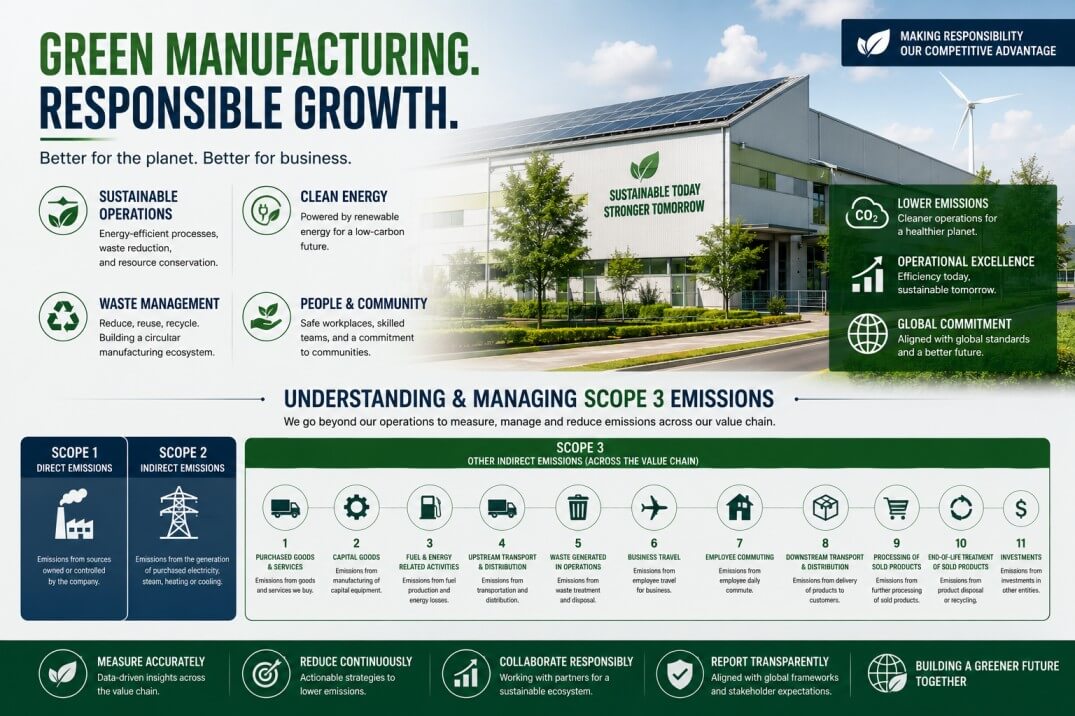
In 2026, Scope 3 supply chain emissions are no longer a sustainability report footnote – they are a procurement criterion, an investor disclosure requirement, and an increasingly literal cost under the EU Carbon Border Adjustment Mechanism (CBAM). For manufacturing companies with net-zero commitments or EU export programmes, the carbon intensity of their supply chain – including the electricity used to manufacture their components – now affects both compliance and cost.
India’s energy transition, combined with its lower-carbon manufacturing profile versus China for specific categories, makes it an increasingly relevant variable in Scope 3 reduction strategy. This article gives procurement and sustainability teams the data they need.
Why Manufacturing Location Affects Scope 3 Emissions
Scope 3 emissions (Category 1: Purchased Goods and Services) are dominated by:
- Electricity used in manufacturing (grid emission factor of supplier country/region)
- Process energy (thermal – coal, gas, oil for furnaces, dryers, kilns)
- Logistics emissions (shipping mode and distance)
- Material extraction and processing (upstream Scope 3)
The single largest variable is grid electricity carbon intensity – the kg of CO2 equivalent emitted per kWh consumed. This varies dramatically by country:
- China national grid average (2025): 0.581 kg CO2e/kWh (coal-heavy grid)
- India national grid average (2025): 0.472 kg CO2e/kWh (improving with renewable additions)
- India Tamil Nadu / Rajasthan grid (high-renewable zones): 0.320-0.380 kg CO2e/kWh
- India industrial parks with captive solar/wind: 0.150-0.250 kg CO2e/kWh
- EU average: 0.233 kg CO2e/kWh
- US average: 0.371 kg CO2e/kWh
For an energy-intensive manufacturing process consuming 500 kWh per tonne of output, switching from China to a renewable-powered India industrial park reduces electricity-related Scope 3 emissions by 40-70%.
India’s Renewable Energy Transition: The Manufacturing Implication
India reached 200 GW of installed renewable energy capacity in 2024 and is targeting 500 GW by 2030. In manufacturing terms, this means:
- Multiple states (Tamil Nadu, Rajasthan, Gujarat, Karnataka) now have renewable energy surplus – enabling genuine green power procurement for industrial consumers.
- Open Access renewable power (directly contracted with generators) is available in most major manufacturing states, enabling manufacturers to lock in low-carbon power at 20-30% lower tariff than grid power.
- Government industrial parks in renewable-energy-rich states offer pre-built renewable supply infrastructure – buyers can specify “green-powered facility” in RFQs.
- India’s national green energy grid corridor investment (Rs 20,440 Cr) is enabling interstate renewable power transfers, democratising access to green power.
Carbon Border Adjustment Mechanism (CBAM) and India Sourcing
The EU’s CBAM, fully phased in from January 2026, applies a carbon price to embedded emissions in imports of steel, aluminium, cement, fertilisers, hydrogen, and electricity from non-EU countries. Importers must purchase CBAM certificates matching the carbon price they would have paid under EU ETS.
India vs China CBAM comparison for steel products (illustrative):
- China steel production: Approximately 2.0-2.4 tonnes CO2e per tonne of steel (blast furnace, coal-based)
- India steel production (DRI/EAF route, Tata Steel, JSW): Approximately 1.4-1.8 tonnes CO2e per tonne
- India steel with green hydrogen DRI (pilot projects in 2026): Below 0.5 tonnes CO2e per tonne (emerging)
- At an EU ETS carbon price of 80 EUR/tonne CO2, the CBAM cost difference between India and China steel can reach 48-80 EUR per tonne – a significant landed cost variable for steel-intensive products.
Building a Green Supply Chain with India Sourcing
Step 1: Measure Current Scope 3 Baseline
Before optimising, measure. Calculate Scope 3 Category 1 emissions using your current China supplier spend data: tonnes of product x emission factor (kg CO2e/kg for typical material and process). Primary sources: supplier-provided EPD (Environmental Product Declaration), IPCC emission factors, or Ecoinvent database.
Step 2: Identify High-Emission, India-Substitutable Categories
Rank your BOM by: Scope 3 emission intensity (kg CO2e/$ spend) x substitutability with India supplier. High-emission, India-substitutable categories include: steel forgings and castings, aluminium die castings, precision machined steel components, and electronics assemblies.
Step 3: Specify Green Criteria in India RFQs
Include in your RFQ: request for supplier’s power purchase agreement (PPA) documentation for renewable energy, electricity consumption per unit of output (allows you to calculate Scope 3 reduction), and supplier’s annual GHG inventory (if available). Prefer suppliers in Tamil Nadu, Rajasthan, and Gujarat industrial parks with documented green power access.
Step 4: Claim and Report the Reduction
Document the emission factor of your India supplier vs previous China supplier. Report the reduction as Category 1 Scope 3 improvement under GHG Protocol. Quantify the avoided carbon cost under CBAM or internal carbon pricing frameworks.
Indian Certifications Relevant to Green Manufacturing
- BEE (Bureau of Energy Efficiency) Star Rating: Indian energy efficiency certification for industrial facilities. Higher star rating = lower energy intensity.
- GreenPro Certification (CII): Indian green product certification for manufactured goods, covering lifecycle emissions, water use, and hazardous substance content.
- ISO 14001 (Environmental Management System): International standard; widely held by export-oriented Indian manufacturers. Verifies systematic approach to environmental management.
- Carbon Disclosure Project (CDP) Supply Chain: Increasingly adopted by large Indian manufacturers supplying to global companies with CDP commitments.
Key Takeaways
- India’s grid carbon intensity is 19% lower than China’s national average and improving rapidly with renewable additions.
- India industrial parks with captive solar/wind power offer emission factors 60-70% below China’s coal-heavy grid.
- EU CBAM creates a direct financial incentive to source steel and aluminium from lower-carbon India manufacturers vs high-carbon Chinese equivalents.
- Specifying renewable energy access and ISO 14001 in India RFQs is achievable and increasingly standard practice for export-oriented Indian manufacturers.
- Scope 3 Category 1 reduction from India sourcing can be material (20-40% per component category) and directly reportable under GHG Protocol.
FAQ
Q: How do I get verified emission data from an Indian supplier for Scope 3 reporting?
A: Request an Environmental Product Declaration (EPD) if the supplier has one. If not, request electricity consumption per unit of output + power purchase documentation. Use the electricity data with CEA (Central Electricity Authority) India published grid emission factors by state to calculate Scope 3 emissions. For higher precision, engage a third-party carbon accounting firm to conduct a supplier-specific LCA.
Q: Does sourcing from India count as “domestic” for US IRA manufacturing content requirements?
A: No. US IRA domestic content requirements specify US-origin manufacturing for maximum incentives. India is not a free trade agreement partner with the US (as of 2026, although negotiations are advancing). For IRA compliance, India sourcing does not qualify for domestic content bonuses but does benefit from standard MFN tariff treatment vs China’s Section 301 tariff surcharges.
Q: What is the carbon footprint of shipping goods from India vs China to the US?
A: India to US East Coast by sea: approximately 18-22 days transit, ~0.010-0.012 kg CO2e per tonne-km (Maersk Emission Factor 2025). China to US West Coast: approximately 14-16 days, similar emission factor. The difference in logistics emissions between India and China sourcing is small relative to the manufacturing process emission difference – typically less than 5% of total supply chain carbon.