Wire Harness Manufacturing in India: Cost Advantage, Capability, and Supplier Qualification Guide
Introduction
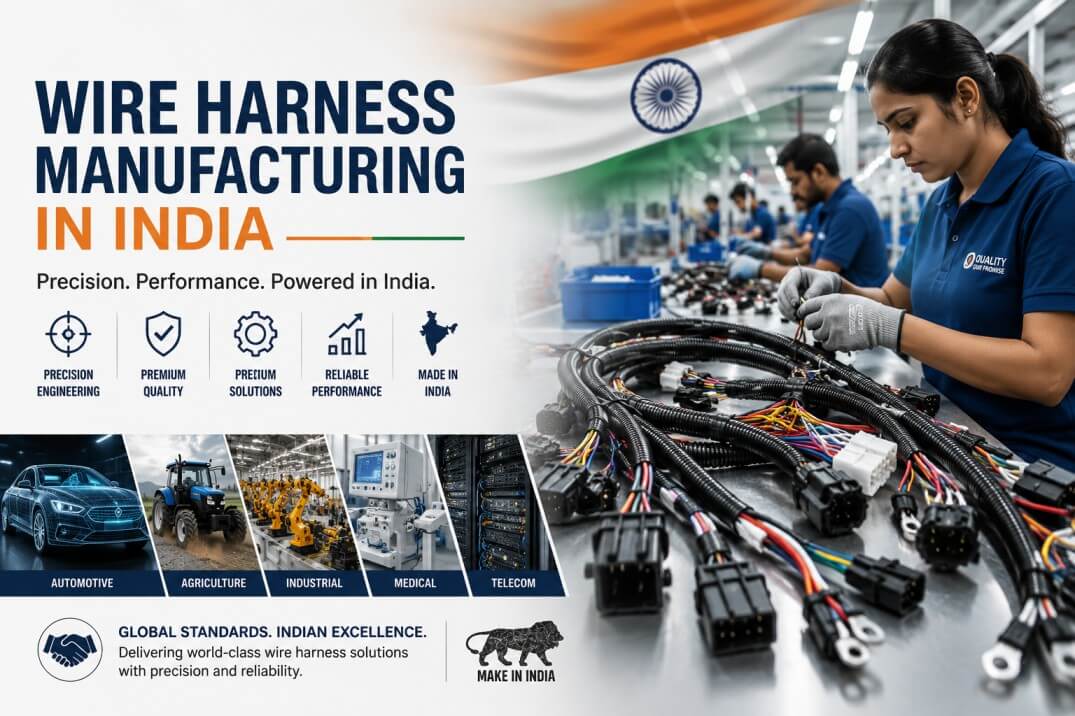
Wire harness manufacturing is the most labour-intensive sub-assembly in automotive and industrial manufacturing. A single passenger vehicle contains 1-3 km of wiring and 500-2,000 electrical connections. At $15-80 per harness (automotive), labour represents 55-65% of total cost. This makes wire harness manufacturing the category where India’s labour cost advantage is most decisive – and why India is already the world’s third-largest wire harness exporter, supplying to Toyota, Honda, Volkswagen, and General Motors assembly lines globally.
This guide covers India’s wire harness manufacturing ecosystem, cost benchmarks, quality standards, supplier qualification, and how to establish India sourcing for harness programmes in 2026.
Why Wire Harnesses Are India’s Strongest Contract Manufacturing Advantage
Wire harness assembly is fundamentally a hand-work intensive process. Automated assembly covers crimping, cutting, and terminal insertion but cannot fully automate the routing, binding, labelling, and quality inspection steps that make harnesses complex. The labour content cannot be automated away – which means the country with the lowest skilled-labour cost wins permanently.
Labour cost comparison for wire harness assembly (2026 estimates):
- China (coastal): $3.80-5.20/hour for harness assembler
- Mexico: $4.50-6.00/hour
- Eastern Europe (Romania, Poland): $7.00-11.00/hour
- India (Tier-1 cities): $1.00-1.60/hour
- India (Tier-2 cities – Hosur, Pune, Nashik): $0.75-1.20/hour
For a harness with 4 hours of assembly labour, India saves $10-16 per unit versus China and $24-40 per unit versus Eastern Europe. At 100,000 units/year, that is $1-4M in annual savings.
India’s Wire Harness Manufacturing Ecosystem
Tier-1 Global Suppliers with India Manufacturing
Motherson Sumi Systems (now Samvardhana Motherson International) is the world’s largest wire harness manufacturer by revenue and operates multiple India plants supplying Toyota, Volkswagen, and Honda globally. Pricol Technologies, Minda Industries, and Spark Minda supply domestic OEMs (Maruti Suzuki, Tata Motors, Mahindra) and export harnesses to Europe and Japan.
Contract Manufacturers for Non-Automotive Harnesses
India has a significant mid-tier harness manufacturing base for industrial, aerospace, defence, and consumer electronics applications. Companies in Pune, Bengaluru, Hosur, and Chennai manufacture harnesses to IPC-A-620 (wiring harness workmanship), DEF STAN, and customer-specific standards. These are the relevant suppliers for non-automotive buyers.
Key Manufacturing Clusters
- Pune / Nashik: Automotive wire harness hub; Motherson, Minda, tier-2 suppliers
- Chennai / Hosur: Auto and electronics harness manufacturing
- Bengaluru: Aerospace and defence harness manufacturing (AS9100 certified suppliers)
- Noida / Gurugram: Industrial and commercial harness manufacturing
Quality Standards for Wire Harnesses: What to Specify
IPC-A-620 (Acceptability of Cable and Wire Harness Assemblies)
The primary quality standard for wire harness workmanship. Specifies acceptability criteria for soldering, crimping, routing, bundling, labelling, and connector insertion. Three classes: Class 1 (general electronics), Class 2 (dedicated service), Class 3 (high-reliability aerospace/defence). Always specify IPC-A-620 Class in your purchase specification and verify supplier holds current IPC Certified Interconnect Specialist (CIS) certification.
USCAR-2 (Automotive Wire Crimp Performance Standard)
The automotive-specific crimp performance standard specifying pull force, cross-section, and electrical resistance requirements for crimped terminals. Required for any automotive-grade harness. Indian automotive harness manufacturers supplying to global OEMs hold USCAR-2 compliance as a baseline requirement.
IPC-J-STD-001 (Soldering)
For harnesses with soldered connections (junction blocks, pigtails, tinned end splices). Specifies soldering materials, flux residue, and inspection criteria. J-STD-001 Class 3 for aerospace/defence, Class 2 for industrial.
AS9100 (Aerospace Wire Harnesses)
Any wire harness destined for aerospace or defence applications requires AS9100 Rev D supplier certification as a minimum. India has AS9100-certified harness manufacturers in Bengaluru and Pune.
The Wire Harness Supplier Qualification Process
Step 1: Define Specification Package
Before issuing RFQs, prepare: harness drawing (or 3D cable design file), wire gauge and material specification, connector part numbers (with AMP/Molex/TE Connectivity or equivalent), environmental requirements (temperature, vibration, IP rating), quality standard (IPC-A-620 Class), testing requirements (hipot, continuity, resistance).
Step 2: RFQ and Supplier Selection
Issue to minimum 3 India suppliers. Evaluate: current customer list (who else do they supply and at what quality level), certification status (IPC-A-620, IATF 16949, AS9100 as applicable), tooling capabilities (crimp press inventory, test equipment), and capacity availability.
Step 3: First Article and Process Qualification
First article inspection (FAI) per harness drawing. 100% dimensional and electrical check on first articles. Review process documentation: work instructions, crimp force monitoring records, operator certifications. Approve process before volume production begins.
Step 4: Production Approval and Ongoing Quality
Issue production purchase order with: AQL sampling plan for ongoing inspection, monthly quality scorecards (PPM defect rate, on-time delivery), annual process audit. India suppliers should achieve PPM below 500 for established programmes; world-class is below 50 PPM.
Lead Times and Logistics for India-Sourced Wire Harnesses
Standard production lead time from approved supplier: 4-6 weeks for standard programmes, 8-12 weeks for new programme with tooling. First article lead time from drawing release: 3-4 weeks.
Logistics: Wire harnesses are high-volume, low-density (bulky, light). Sea freight is preferred for annual programmes. India to US East Coast: 22-26 days. India to Europe: 16-20 days. For automotive JIT supply, airfreight supplements during ramp-up or expedites. Consider India-based bonded warehousing for volume programmes to reduce effective lead time to 1-2 weeks.
Cost Benchmarking: What to Expect from India Quotes
For a representative automotive door harness (40 circuits, 2.2m length, 180 terminals, USCAR-2 qualified):
- China quote (Tier-2 manufacturer): $22-28 per assembly
- Mexico quote (Tier-2 manufacturer): $26-34 per assembly
- India quote (Tier-2 manufacturer): $14-19 per assembly
India is 30-40% cheaper than China on unit price before tariffs. With 25% Section 301 tariffs on Chinese wire harnesses, India’s landed cost advantage in the US market exceeds 50%.
Key Takeaways
- Wire harness manufacturing is the highest-ROI India sourcing category: 30-40% lower unit cost than China, zero tariff exposure, established ecosystem.
- India has tier-1 global harness manufacturers (Motherson) and a deep tier-2 contract manufacturing base for custom programmes.
- IPC-A-620 (workmanship), USCAR-2 (automotive crimp), and AS9100 (aerospace) are the relevant quality standard triplet to specify.
- Qualification from RFQ to first article approval: 6-10 weeks for standard harnesses.
- India harnesses are not just cheaper – India’s established global automotive customer base (Toyota, VW, Honda) validates quality at production scale.
FAQs
Q: Can India suppliers handle complex aerospace wire harnesses with shielding, backshell connectors, and MIL-spec wire?
A: Yes – Bengaluru and Pune have AS9100-certified harness manufacturers experienced in MIL-W-22759 wire, MIL-C-26482 connectors, EMI backshell, and coaxial harness assemblies. Reference programmes include supply to Airbus, HAL, and DRDO. Qualification of a new aerospace harness programme typically takes 9-15 months including DFM, FAI, and first-flight approval.
Q: What is the minimum order quantity for India wire harness sourcing?
A: For custom harnesses, minimum economic order is approximately 500 pieces/year. Below that, tooling amortisation (crimp tooling, test fixture) makes India less competitive than domestic assembly. For standard harness assemblies using off-the-shelf connectors, even smaller quantities are viable.
Q: How do I manage harness design changes in an India-sourced programme?
A: Establish a formal engineering change control process with your India supplier: all drawing changes go through a change note with FAI trigger for dimensional or electrical changes. India suppliers with automotive experience have mature ECN processes. Budget 2-3 weeks for FAI on significant changes.