Injection Moulding in India: Complete Guide to Plastic Part Manufacturing and Sourcing
Introduction
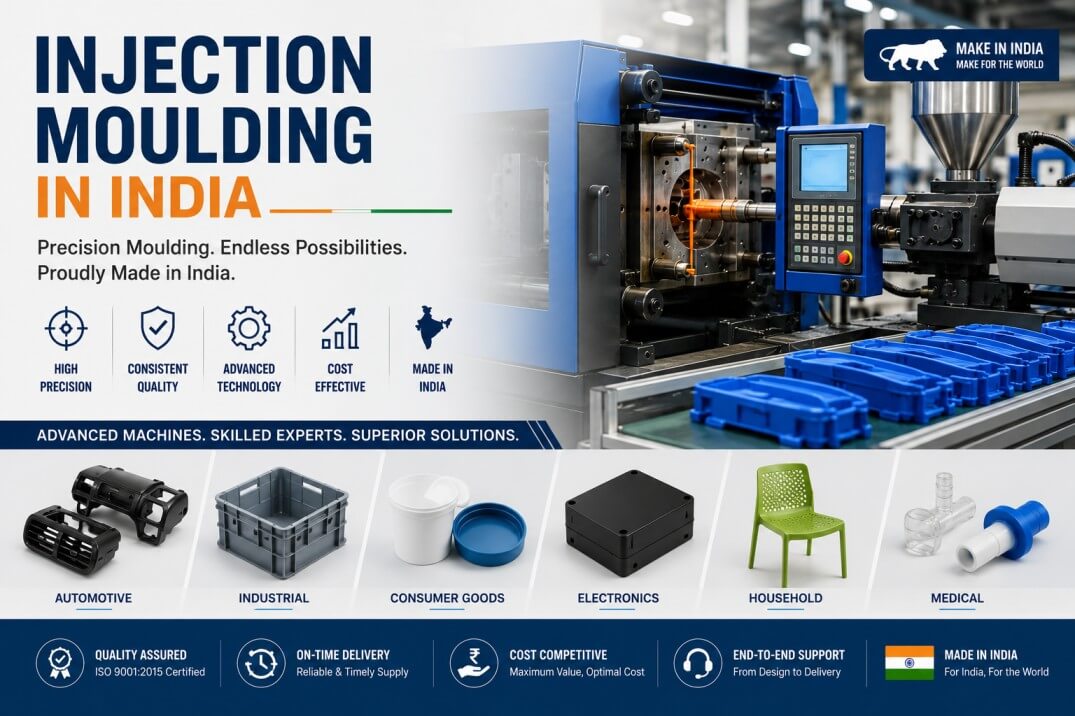
India processes over 12 million tonnes of plastic annually and has more than 30,000 plastics processing units. Yet most global buyers sourcing injection moulded parts default to China without evaluating India – leaving 20-35% cost savings on the table for non-cosmetic, industrial, and automotive plastic parts where India is genuinely competitive. This guide maps India’s injection moulding ecosystem, what it can and cannot do, how to specify parts correctly, and how to qualify Indian moulders for global supply programmes.
India’s Injection Moulding Ecosystem: Capabilities and Clusters
Automotive Plastic Components – Mature and Export-Ready
India’s automotive plastic parts industry supplies to Maruti Suzuki, Hyundai, Tata Motors, and through tier-1 suppliers (Motherson, Faurecia India, Pricol, Varroc) to global automotive OEMs. Capabilities include: instrument panels, door trim assemblies, bumper systems, fuel system components, under-hood parts in PA66, PBT, and HDPE. IATF 16949-certified moulders are the norm for automotive.
Industrial and Engineering Plastics – Growing
Engineering plastic moulding (PA, POM, PPS, PEEK, PEI) for industrial applications: pump housings, valve bodies, bearing retainers, conveyor components, and electrical enclosures. Manufacturers in Pune, Ahmedabad, and Bengaluru handle engineering plastics with in-house tool rooms.
Consumer Electronics and Appliance Components – Competitive for Functional Parts
India moulders produce functional enclosures, connectors, and internal components for consumer electronics assembled in India (primarily for Foxconn, Tata, and Samsung’s India operations). For Class-A cosmetic surface finish consumer products (phone casings, premium appliance aesthetics), China remains ahead on mould polish quality and cycle time.
Medical Device Components – Developing
ISO 13485-certified injection moulding for medical grade plastics (HDPE, PP, ABS, PC, PSU, PEEK) is growing. Cleanroom moulding facilities (ISO Class 7/8) are available in Pune, Hyderabad, and Chennai. India Medical Device Rules (MDR 2017) compliance is the regulatory framework for India-market devices; for export programmes, FDA 21 CFR Part 820 or EU MDR compliance is required.
Tooling (Mould) Costs in India vs China
Tooling cost comparison for a typical single-cavity injection mould:
- Simple part (no lifters, 2-plate tool): China $2,500-6,000 | India $3,500-8,000
- Medium complexity (4-plate, slides): China $8,000-20,000 | India $10,000-25,000
- Complex part (hot runner, multiple slides, high polish): China $20,000-60,000 | India $28,000-80,000
- Multi-cavity mould (8-cavity, standard): China $12,000-30,000 | India $15,000-38,000
India’s tooling cost premium over China is 20-35%. However, for programmes where the buyer intends to keep tooling in India (for supply chain security, tariff avoidance, or import duty reasons), the tooling premium is a one-time cost recovered quickly through lower unit prices.
Unit Cost Comparison: When India Is Cheaper
India moulding unit costs are competitive vs China for:
- Parts with high assembly labour content (insert moulding, overmoulding): India wins by 25-35%
- Large structural/industrial parts (wall thickness above 3mm, high shot weight): India competitive within 10%
- Low-to-medium cavitation tools (1-4 cavity): India competitive
- Engineering plastics with manual insert loading: India wins by 20-30%
India is less competitive than China for:
- Ultra-high-cavitation moulds (16+ cavity, thin-wall consumer packaging): China’s mould precision and cycle time optimisation is superior
- Class-A cosmetic finishes for consumer electronics: Chinese mould polishing and EDM texture capability is ahead
- Very high volumes requiring 24/7 automated cells: China’s automation investment is greater
DfM Rules for India Injection Moulding: What to Check Before Tooling
Wall Thickness
Uniform wall thickness is the single most important DfM rule. Nominal wall should be 2-4mm for most engineering plastics. Variation greater than 25% from nominal creates sink marks and warpage. For thin-wall moulding (below 1.5mm), specify to moulders with documented thin-wall experience.
Draft Angles
Minimum 1 degree draft on all vertical walls for easy ejection. Textured surfaces require 3-5 degrees. Insufficient draft causes drag marks and ejection damage – the most common DfM mistake from engineers who work in metals.
Gate Location
Gate location affects weld line position, surface finish, and filling pressure. Work with the moulding supplier on gate location during DfM review – before tooling is cut. Moving a gate after tool fabrication is costly.
Undercuts
Undercuts require side actions (slides or lifters) which add $500-5,000 per action to tooling cost. Redesign to eliminate undercuts where possible; if unavoidable, call them out explicitly in the design review.
Sink Marks and Boss Design
Boss wall thickness should be 60-70% of nominal wall. Ribs should be 40-60% of nominal wall. Exceeding these ratios creates sink marks on the opposite face. This is a non-negotiable rule for appearance surfaces.
Quality Standards for Injection Moulded Parts in India
- Automotive: IATF 16949 (quality management system), customer-specific requirements (VDA 6.3 for VW-group, AIAG PPAP for US OEMs)
- Industrial: ISO 9001 as minimum; EN/ISO 10350 for material property verification
- Medical: ISO 13485, cleanroom certification per ISO 14644, material biocompatibility per ISO 10993
- Electronics: IEC 60695 (flammability), UL 94 rating on resin selection
- Food-contact: FDA 21 CFR food contact approval on resin, EU 10/2011 migration testing
How to Qualify an India Injection Moulding Supplier
Toolroom Assessment
Visit or audit the in-house tool room (or confirm tool shop relationship for outsourced tooling). Check: CNC machining and EDM equipment (age, maintenance), mould steel standard used (P20, H13 for standard tools; S136, 420 SS for corrosive resins), mould flow simulation capability (Moldflow or equivalent).
Press Fleet Assessment
Injection moulding presses are rated by clamping force (tonnes). Check: press fleet size and age (equipment under 10 years preferred), clamping force range (needs to match your part projected area), process controls (closed-loop pressure/velocity, temperature controllers), maintenance records.
Material Management
Verify: incoming material inspection (MFR/viscosity testing on each lot), drying equipment (dehumidifying dryers for hygroscopic resins: PA, PC, PET, PBT), material traceability to lot number, segregation of medical-grade vs industrial-grade resins.
Key Takeaways
- India is cost-competitive for injection moulding in automotive parts, industrial engineering plastics, and labour-intensive assemblies (insert moulding, overmoulding).
- India’s tooling costs are 20-35% higher than China but recovered through lower unit costs on medium-to-high volume programmes.
- China retains an advantage for Class-A cosmetic consumer electronics and ultra-high-cavitation thin-wall packaging.
- DfM review before tooling – specifically wall thickness, draft, gate location, and undercuts – is the single highest-leverage quality intervention.
- India has IATF 16949, ISO 13485, and ISO 9001-certified moulders for automotive, medical, and industrial programmes respectively.
FAQ
Q: Can India moulders handle overmoulding (TPE over rigid substrate) and 2K moulding?
A: Yes – multiple India moulders have 2K (two-component) and overmoulding capability for automotive soft-touch interiors, industrial grips, and sealing applications. Specify 2K capability explicitly in your RFQ and request reference parts during qualification.
Q: How do I specify colour matching for injection moulded parts from India?
A: Specify Pantone or RAL colour reference. Require colour master approved prior to production (limit sample process). Specify Delta-E tolerance (typically Delta-E below 1.0 for automotive, below 2.0 for industrial). Request colour control plan from the supplier showing measurement frequency and instrument (spectrophotometer).
Q: What import duties apply to India-origin plastic parts entering the US and EU?
A: Most injection moulded plastic components from India enter the US at standard MFN duty rates of 2.5-6.3% depending on HTS code – far below the 25%+ Section 301 rates applying to Chinese-origin equivalents. EU-India FTA negotiations in 2025-2026 are expected to further reduce or eliminate duties on Indian-origin manufactured goods.